Javoryx
Path Edition
Path Edition
Couldn't load pickup availability
Self-paced learning overview
- 📥 Digital file available after purchase
- ♾️ Long-term availability
- 🔒 Secure checkout
- 🗓️ Content updated in 2026
1. Problem Statement
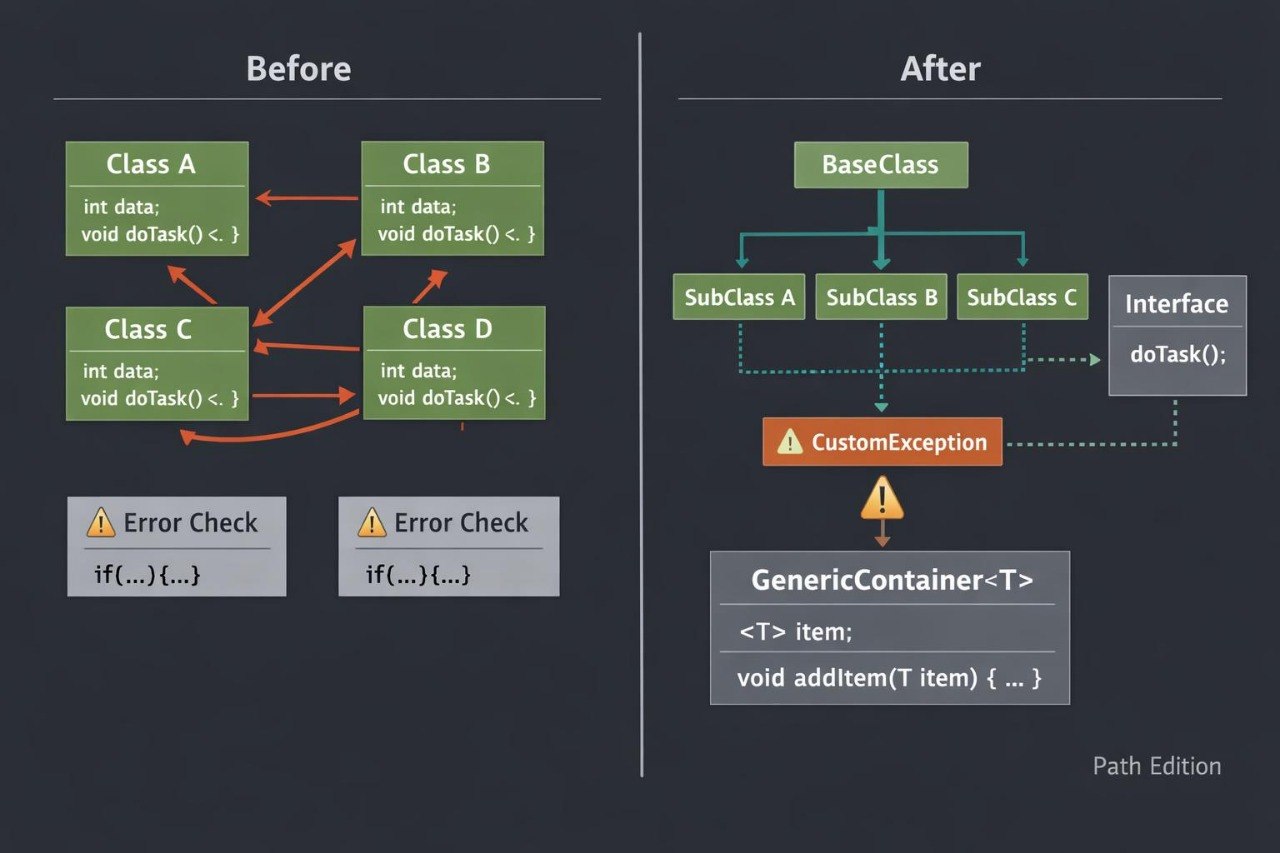
Struggling to extend a Java program without repeating the same fields, methods, and checks? You’re not alone in facing this issue after creating your first models with several classes. Related objects may share common characteristics, while it can be difficult to decide where those characteristics should be defined. Additional questions appear when a program must respond to invalid values or unexpected situations. Without a considered structure, code may gradually become longer, and one change can require edits across several connected classes.
2. Solution
This course will teach you how to create extendable program models with Java language mechanisms. You will study how inheritance places shared characteristics within a base class. The materials explain the difference between abstract classes and interfaces and present suitable situations for each approach. A dedicated section covers exceptions, data validation, and controlled responses to errors. You will also work with generic types to create structures that can process different kinds of data.
3. What’s Inside
Module 1: Shared Behaviour and Inheritance
Identify common fields and methods, create base and derived classes, and examine the order in which constructors are called.
Module 2: Method Overriding
Learn how derived classes can redefine inherited behaviour while following a shared interaction format.
Module 3: Abstract Classes
Study classes that provide a common foundation while leaving selected behaviour for individual subclasses to implement.
Module 4: Interfaces and Contracts
Describe groups of actions through interfaces and apply the same rules to objects with different class structures.
Module 5: Polymorphic Collections
Store objects from different classes in one collection and call the behaviour assigned to each object type.
Module 6: Exception Handling
Work with try, catch, and finally, create exceptions, and pass information about problems through the program.
Module 7: Generics in Reusable Structures
Create classes and methods with generic types and identify type-related issues while writing code.
Module 8: Extended Java Model
Complete an applied assignment combining a class hierarchy, interfaces, collections, value validation, and exception handling.
4. Who Is This For?
✅ This tier may suit you if you:
- already create classes, objects, and methods;
- want to reduce repetition across related classes;
- would like to understand interfaces and abstract classes;
- want to handle invalid data in an organized way;
- are ready to work with models containing several levels.
❌ This tier may not match your needs if you:
- have not yet worked with constructors and object collections;
- are looking only for an overview of introductory syntax;
- do not plan to complete assignments involving several classes.
5. What You’ll Learn
After completing the materials, you will be able to:
- create base and derived classes;
- override methods for different object types;
- distinguish between interfaces and abstract classes;
- work with polymorphic collections;
- create and handle exceptions;
- validate values before processing them;
- write methods and classes with generic types;
- reorganize repeated sections of code;
- complete at least eight topic-based exercises;
- build a program model containing at least five connected classes.
6. Refund Terms
A refund request for Path Edition may be submitted within 30 calendar days of the order date. Each request is reviewed according to the refund policy in effect when the course was purchased. The policy describes the submission process, review period, and possible exceptions. Learners should read the complete terms before placing an order.
7. Certificate
Learners may receive a Javoryx certificate after completing all modules and required assignments included in Path Edition. The certificate confirms completion of the course materials but does not represent a diploma, licence, or occupational qualification.
1. What format are the learning materials provided in?
1. What format are the learning materials provided in?
Each tier contains structured digital materials focused on Java Programming. Depending on the selected option, it may include themed modules, written explanations, code examples, practical tasks, review questions, and supporting resources. The exact contents are listed on the page of each course tier.
2. Do I need previous Java Programming knowledge?
2. Do I need previous Java Programming knowledge?
The recommended background depends on the selected tier. Introductory options cover basic syntax and program logic, while broader tiers explore objects, collections, data handling, and code organization. The suggested knowledge level is stated in every course description.
3. Can I study at my own pace?
3. Can I study at my own pace?
Yes. The materials are organized so learners can plan their own study schedule, return to previous topics, and repeat practical tasks when needed. Following the modules in the listed order is recommended because later topics build on earlier explanations.
4. Are a certificate and refunds included?
4. Are a certificate and refunds included?
A certificate may be provided after the learner completes all required modules and tasks included in the selected tier. Eligible paid tiers may be covered by a 30-day refund policy according to the terms published by the store. Refund terms do not apply to the free tier because no payment is collected.
Share