Javoryx
Nexus Module
Nexus Module
Couldn't load pickup availability
Self-paced learning overview
- 📥 Digital file available after purchase
- ♾️ Long-term availability
- 🔒 Secure checkout
- 🗓️ Content updated in 2026
1. Problem Statement
Struggling to understand how classes, objects, and methods should work together in one Java program? You’re not alone in facing this challenge after studying variables, conditions, and loops. Individual definitions may appear understandable, while practical tasks raise questions about where data and actions should be placed. As a result, one class may contain too many responsibilities, and values may move between program parts without a consistent structure. Without a clear view of object relationships, reading, extending, and reviewing larger sections of code becomes more difficult.
2. Solution
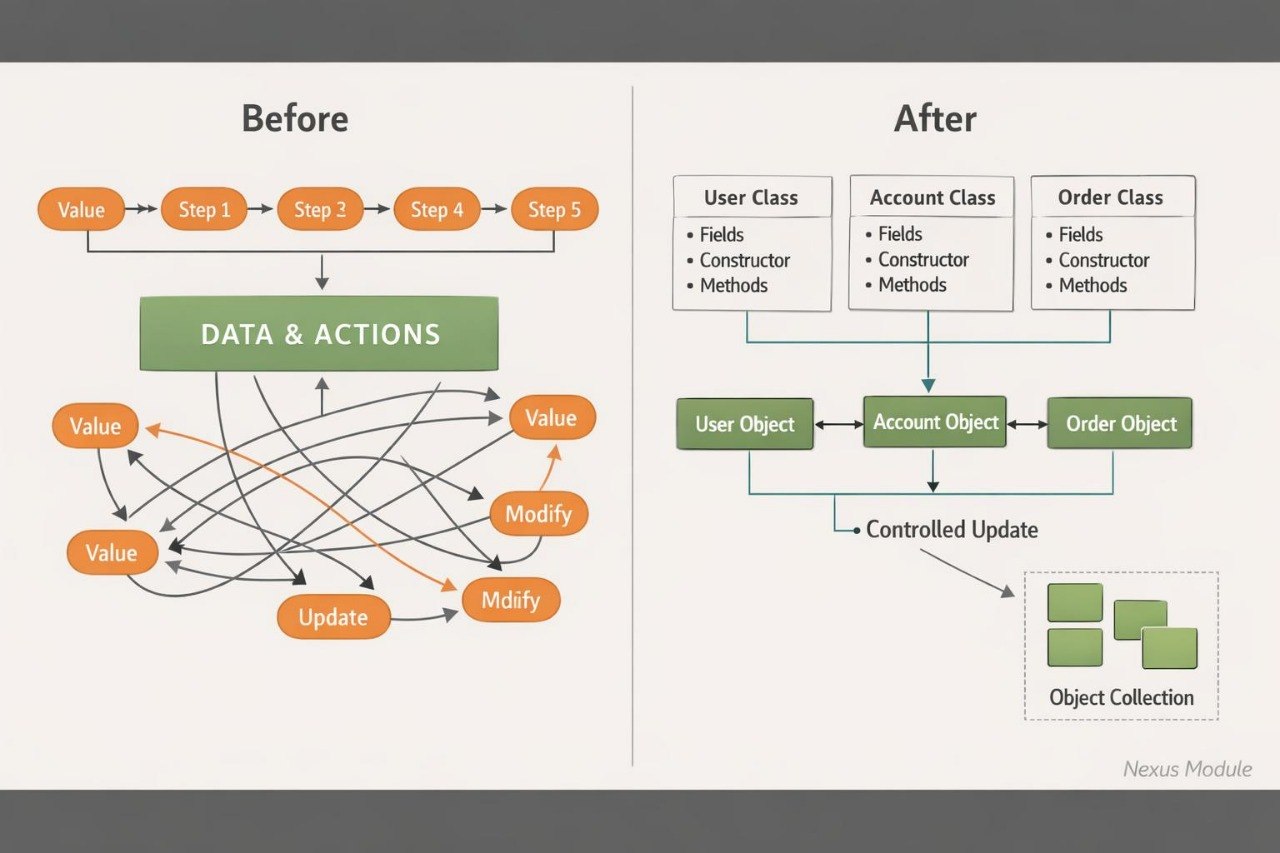
This course will teach you how to create Java programs using classes and objects. You will study how to define fields, write constructors, and add methods that work with an object’s current state. The materials explain how one object can receive information from another and perform a defined part of a shared task. Dedicated exercises demonstrate how to control direct data changes and keep class structures readable. The final assignment combines several related entities within one program model.
3. What’s Inside
Module 1: From Instructions to Objects
Compare sequential code with a program divided into classes and identify which information and actions belong to each entity.
Module 2: Classes and Fields
Create classes, declare fields, store object state, and select suitable data types for different values.
Module 3: Constructors and Initial Values
Write constructors, pass initial values, and check whether a newly created object begins with an appropriate state.
Module 4: Methods and Object Behaviour
Create methods that update or return information, complete calculations, and describe the actions an object can perform.
Module 5: Encapsulation and Data Control
Study visibility modifiers, controlled updates, and interaction with internal information through defined methods.
Module 6: Object Connections
Learn how one class can store a reference to another object, send values to it, and receive a result.
Module 7: Collections of Objects
Work with groups of objects by adding, locating, updating, filtering, and iterating through stored entries.
Module 8: Connected Java Model
Complete an applied assignment involving several classes with separate roles and defined relationships.
4. Who Is This For?
✅ This tier may suit you if you:
- have already worked with variables, conditions, loops, and methods;
- want to understand object-oriented structure in Java;
- would like to divide code between several classes;
- want practice with connected objects and shared tasks.
❌ This tier may not match your needs if you:
- have not studied introductory Java syntax;
- are looking only for a brief overview without assignments;
- already create large systems with many connected components.
5. What You’ll Learn
After completing the materials, you will be able to:
- define the purpose of a class within a program model;
- create objects with stated initial values;
- add fields, constructors, and methods;
- control changes to internal object information;
- divide responsibilities between several classes;
- pass objects as method arguments;
- create relationships between program entities;
- add and locate objects within a collection;
- complete at least eight topic-based exercises;
- build a model containing at least three connected classes.
6. Refund Terms
A refund request for Nexus Module may be submitted within 30 calendar days of the order date. Requests are reviewed under the refund policy published by the store when the course is purchased. That policy describes the submission process, possible exceptions, and other applicable conditions. Learners should review the complete policy before placing an order.
7. Certificate
Learners may receive a Javoryx certificate after completing all modules and required assignments included in Nexus Module. The certificate records completion of the course materials but does not represent a diploma, licence, or occupational qualification.
1. What format are the learning materials provided in?
1. What format are the learning materials provided in?
Each tier contains structured digital materials focused on Java Programming. Depending on the selected option, it may include themed modules, written explanations, code examples, practical tasks, review questions, and supporting resources. The exact contents are listed on the page of each course tier.
2. Do I need previous Java Programming knowledge?
2. Do I need previous Java Programming knowledge?
The recommended background depends on the selected tier. Introductory options cover basic syntax and program logic, while broader tiers explore objects, collections, data handling, and code organization. The suggested knowledge level is stated in every course description.
3. Can I study at my own pace?
3. Can I study at my own pace?
Yes. The materials are organized so learners can plan their own study schedule, return to previous topics, and repeat practical tasks when needed. Following the modules in the listed order is recommended because later topics build on earlier explanations.
4. Are a certificate and refunds included?
4. Are a certificate and refunds included?
A certificate may be provided after the learner completes all required modules and tasks included in the selected tier. Eligible paid tiers may be covered by a 30-day refund policy according to the terms published by the store. Refund terms do not apply to the free tier because no payment is collected.
Share